
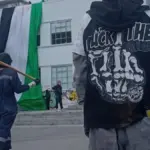
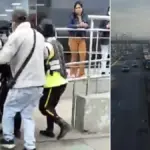
In the Pacific, sadness and fear are felt differently. Faces, usually happy, do not easily fill with sorrow. But this week, in Quibdó, the feeling is different. People look far away in some neighborhoods. Others talk among themselves about anything but the earthquake, as if what they experienced on Monday had not happened. Others prepare community pots to feed those who lost everything.
Walking through Quibdó after the earthquake is to encounter a city trying to keep functioning while still picking up the pieces of what happened. While in the city center life seems to go on as if nothing happened, in neighborhoods like Flores Buenaños, Medrano, Las Palmas, Obrero, and El Futuro, things are different. There are streets where neighbors gather around destroyed houses. There are people cleaning, removing furniture, setting aside bricks, and searching through the rubble for anything that might still be useful. There are homes with huge cracks and buildings that remain closed. In some houses, no one dares to sleep inside, and there is rubble from which the smell of death does not stop coming out.
The city is full. There are rescuers, volunteers, nurses, police, military. Dozens of people arrive by plane and by land every day to help a population that has historically been forgotten and that at the beginning of this week made all the headlines when the magnitude 7.4 earthquake that struck the country last Monday claimed 13 lives here. In Quibdó, there is a fear that appears when a wall creaks, when a door moves, or when someone mentions a new aftershock. Many of the inhabitants we met seem to be waiting for something. They do not know exactly what. But they feel that something can still happen.
The preliminary report from the Chocó Government allows the emergency to be measured. In its Situation Report number 10, as of August 12 at 6:05 p.m., 13 people were recorded dead, 182 injured, and none missing. There were 8,056 displaced families and 4,027 affected, for a total of 21,216 displaced and 24,662 affected people in 29 municipalities. Also reported were 1,144 destroyed homes, 8,868 damaged, and seven affected vehicular bridges.
But the numbers change when walking through the neighborhoods. In Medrano, in the El Piñal sector, we found Antony Roldán picking up the remains of the house where he had lived for 31 years. He was accompanied by friends and neighbors. There was no hired crew nor machinery doing all the work. It was them, all together, removing what was left of a two-story house where seven people lived. Antony’s car was also buried under the rubble.
His story is similar to that of many Quibdó residents: a life slowly built that in seconds turned into a mountain of bricks, wood, and dust. When the earthquake started, Antony was exercising. His father had already left for work. In the house were his mother, sister, wife, and daughter. They tried to get out, but the stairs were the first to give way. They were trapped.
Antony returned after feeling the movement and with the premonition that something was wrong. On the way, he had to get off the bike after falling. When he arrived in the neighborhood, a neighbor told him his house had collapsed. For a few seconds, he thought he had lost his family. With several neighbors, he began searching through the remains and shouting their names. They answered from inside. They were alive. His mother, however, had to spend two days in a hospital after receiving a blow to the head. Tests ruled out neurological damage, and she was finally able to return.
Now Antony has to think about how to rebuild a house that was the result of 31 years of life. A borrowed home serves as temporary shelter. Friends, family, and strangers have brought him clothes and other aid. But while his neighbors clear the rubble, he looks at what remains and thinks about how to start over.
And in Quibdó, starting over seems to be the phrase that repeats itself. In Flórez Buenaños, one of the most affected sectors, destruction is also visible. There are homes with completely cracked walls. A three-story house completely collapsed. Another three-level structure, where seven apartments operated, also fell.
Irma Murillo Valderrama is one of the neighborhood leaders and as soon as she sees journalists arriving, she calls us excitedly. They want to tell their story. They say no one has come. The neighbors there had to organize quickly. They estimate that more than a thousand families were affected in the sector. She herself lived through the earthquake alone in her house. She had just finished praying and was replying to a work message when the movement began. At first, she thought it would be one of those brief tremors the region’s inhabitants are used to. But this time it did not end quickly.
The intensity increased. The door of her house got stuck by the movement, and she had to find an exit through the back. Later, when she went out and saw what had happened, she understood that the city was facing a different emergency. In Flórez Buenaños, neighbors began putting money and food together to prepare meals for those who had lost everything. Some contributed 20,000 pesos, others 50,000. Others brought non-perishable products. This is how the community pots began, which still operate several days after the earthquake. The kitchen became a form of resistance. In one house water is stored. In another, food is kept. In another, food is prepared. Outside, some people sleep because they do not want to go back inside their homes.
The first aid, neighbors say, came from friends, family, and people from the private sector. Then institutions and machinery to remove rubble began to arrive. The neighborhood, however, had to make itself visible by its own means. Neighbors recorded videos and posted them on social media to show that they also needed help. Then media, officials, mats, water, and supplies arrived. Now aid is distributed among families depending on the level of impact.
The scene repeats itself in different parts of Quibdó: neighbors turned into cooks, storekeepers, rescuers, and improvised builders. People who barely knew each other before the earthquake now work together so that no one goes hungry. Jessica del Pilar Moreno Machado is also living that transformation. On the day of the earthquake, she had taken her children to school and was finishing organizing herself to go to work. Then the doors of her home slammed shut violently. She had to ask for help to get out.
From that moment, her house stopped being just her house. It also became a small collection center for neighbors. Aid is received and stored there. Food is cooked there. People who need water or food gather there. There, too, an attempt is made to maintain a routine amid the chaos. Jessica has two children. During the earthquake, they were at Carrasquilla school, the largest educational center in the department, which remains closed today. For a few moments, she did not know where they were. Then she managed to find them together. That reunion was one of the few moments of relief amid a morning of anguish.
Now, every time she enters her home, she feels the tremor again even though the ground remains still. Fear has settled in her body. The feeling that the walls move again appears even when nothing happens. And while she tries to clean and organize, she also thinks about what is coming. The house where she lives will have to be rebuilt.
In Quibdó, hundreds of people are living similar situations: families who lost their homes, people looking for somewhere to sleep, merchants who lost their businesses, and residents who still do not know when they will be able to return to their homes. The city tries to return to normal, but normality seems far away.
Schools are closed. Some buildings remain sealed. The streets still have rubble. Rescue organizations continue attending critical points. Families await evaluations of their homes and answers about the aid they will receive. And meanwhile, life goes on around the ruins.
A community pot boils in a corner. A group of neighbors cleans a house. A woman hands out water. A man carries a block. Someone asks about a relative. Another looks at the phone to see if there was a new aftershock. There is something particular about that scene: no one seems completely sure that the emergency is over.
In conversations, the same concern appears again and again. If such a magnitude earthquake has already happened, what can happen next? The aftershocks keep people alert. Every movement is a reason to go outside. Every strange noise awakens fear.
Fear is not always expressed with tears. Sometimes it is simply a person staring at a wall for several seconds. Or someone who prefers to sleep outside. Or a mother who checks where her children are before going to bed. Or a neighbor who, even though his house is still standing, no longer feels safe inside it.
That is what is felt in Quibdó. A city that cooks to survive, that clears rubble to rebuild, that searches among the ruins for objects that can still be rescued, and that helps itself because it knows it cannot wait for everything to come from outside. But also a city that is tired, scared, and looks at the sky, the ground, and the walls trying to guess what is coming.
In the Pacific, people usually learn to resist in community. Quibdó is showing once again that it knows how to do it. Only this time, while picking up the remains of Monday, it does so with a question that lingers in the air and that no one seems able to answer: Has the worst already passed?
EDWIN CAICEDO
Environment and Health Journalist
@CaicedoUcros